· K. Larkin · Future-Self Writing · 16 min read
Science of Writing to Your Future Self
The science behind writing to your future self: six research-backed benefits, from saving more to keeping your word. The cheapest way to change your life.

The Science of Why Writing to Your Future Self Works: The Cheapest Behavior-Change Tool Science Has Found
I found a letter I wrote to my future self at twenty-nine, and I didn’t recognize the woman who signed it.
To be her again!
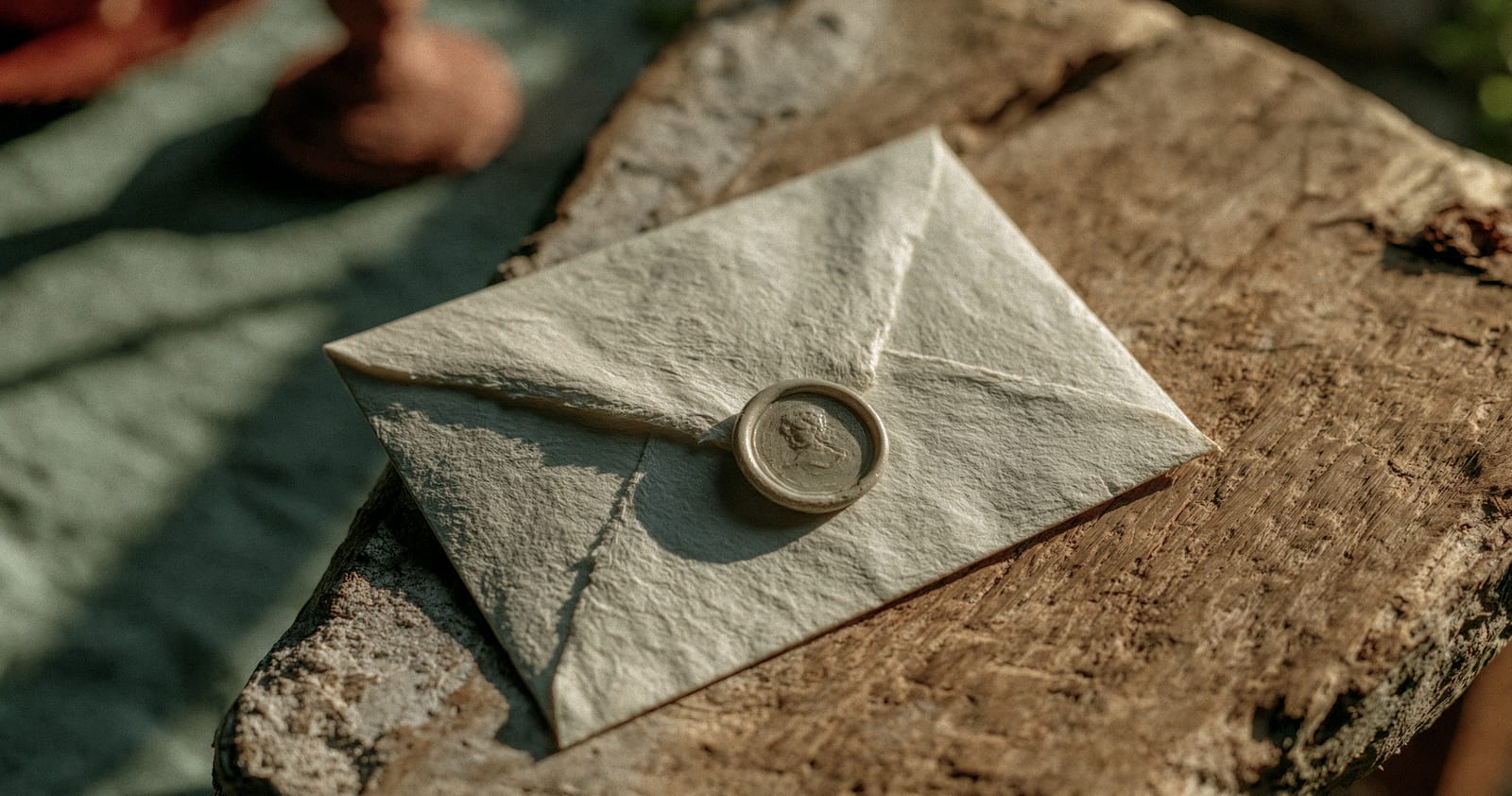
I’d written it in green fountain pen ink on the back of a room-service menu from Las Vegas on New Year’s Eve, sealed it, and forgotten it. I found it 20-some years later, tucked inside the first Harry Potter book.
Her handwriting was mine. Her worries were not. She was pretty focused on career, marriage, kids, settling down.
Now I’m focused on the opposite: unsettling and exploring, finding adventure.
I read it twice. I cried. Maybe for the life I didn’t have? Maybe for the life I did have? Maybe just because she cared how I ended up.
This guide is the research: the real benefits of writing to your future self, and the surprising pile of research underneath a practice that looks, from the outside, like a craft project. Most of that research says the same quiet thing: a few minutes and a sealed envelope shift how you save, decide, follow through, and feel.
Writing your future self is the cheapest behavior-change tool science has found.
What’s in This Guide
Six benefits, in the order they unfold. Each one has the study behind it, linked so you can check my work:
- Why future-you feels like a stranger, and why getting to know future-you changes everything
- How it shows you the life you are meant to be living
- How it hands you your own best advice
- How it gives the heavy things somewhere to go
- How it gets a goal out of your head, where goals go to die
- How it turns a daydream into something you’ll actually do
Why Future-You Feels Like a Stranger
Your brain treats the future version of you a little like it treats a person you’ve never met.
That is not a figure of speech.
It’s a brain scan.
Researchers at Stanford slid people into an fMRI scanner and asked them to think about themselves today, then about themselves ten years out, then about a stranger. When people considered their present selves, a particular strip of the brain lit up, the part that handles me. When they considered their future selves, that same strip went quieter, drifting toward the pattern it makes for someone else entirely (Ersner-Hershfield, Wimmer & Knutson, 2009).
A week later, the people whose brains had treated future-them most like a stranger were also the ones who grabbed the smaller reward now instead of the larger one later. The stranger in the scanner became the stranger in their choices.
Sit with what that explains.
Every time you put off the dentist, skip the savings transfer, or leave the hard conversation for “later me,” you are handing a bill to someone your brain has quietly filed under not quite me.
A letter turns that finding to your advantage. When you write to your future self by name, you’re introducing yourself to that stranger. You’re making them a real person, with a face and a stake, someone worth protecting instead of billing.
And the closeness pays.
In a companion set of studies, people who spent a few minutes with a realistic, age-progressed image of their own face, the older version, lined and grayer, went on to allocate roughly a third more of their money toward retirement than people who hadn’t met that face (Hershfield et al., 2011). Meet the older you, even briefly, and you start treating them like family instead of a distant acquaintance you’ll never have to face.
A sealed letter does the same work with paper instead of a scanner. It’s the least expensive introduction you’ll ever make: you, meet you. (We go deeper on why your future self is a stranger, and what it means for your money, in a companion piece.)
How It Shows You the Life You Meant to Be Living
Most of us carry a low background hum of drift. The sense that the life we’re living and the life we once meant to live have quietly come apart, and we can’t quite point to where. Writing about your best possible future self is how you find the seam.
A psychologist named Laura King ran the study that put numbers to this. She had eighty-one people write for twenty minutes a day, four days running. One group wrote about their “best possible self”: life several years out, with the instruction to imagine that “everything has gone as well as it possibly could,” that they’d worked hard and reached the things they quietly hoped for. Another group wrote about neutral topics. The best-possible-self writers came away with a measurable lift in well-being within weeks. Months later, they’d made fewer visits to the health center for illness (King, 2001).
Twenty minutes a day, for four days, and the effect was still visible in their bodies months on.
Notice what the exercise is not. It’s not vague affirmation, the sticky-note-on-the-mirror kind. It’s specific, and it’s written, which is a harder and more useful thing. When you have to put the good life into actual sentences, you’re forced to admit what you actually want, in detail, on the record.
That’s what a letter to your future self does that a daydream can’t. A daydream stays soft and moves around. A letter picks one version, names it, and dates it. You’re not just hoping for a better life. You’re describing it to the person who’s going to live it, and asking them how it turned out.
How It Hands You Your Own Best Advice
You already give better advice than you take. There’s a name for that gap, and a small trick that closes it.
Psychologists call it Solomon’s paradox, after the king famous for dispensing brilliant wisdom to everyone around him while his own household fell into disarray. In a series of experiments, people reasoned more wisely about a friend’s relationship problem than about their own identical one. Given someone else’s mess, they were more willing to compromise, more able to admit the limits of what they knew, quicker to see how things might change. Handed their own mess, that same wisdom went dim (Grossmann & Kross, 2014). Same person, same problem, and the only thing that changed the quality of the thinking was whose problem it was.
The fix the researchers found is almost too simple: create a little distance. Reflect on your own situation as though it were happening to someone else. Ask what you’d tell a friend in exactly this spot.
A letter to your future self has that distance built into it. You’re writing to a you who isn’t quite you, and that small gap is precisely the vantage point where your own good sense switches back on. It’s why the practice can feel less like journaling and more like taking counsel from your wisest friend. The friend is you. You’re just standing far enough back to see straight.
This is the benefit I lean on most. Not because I’m short on advice, but because I’m short on distance from myself, the way most of us are.
How It Gives the Heavy Things Somewhere to Go
Writing about what’s weighing on you tends to leave you a little lighter. The effect is real, and it’s honest to say it’s modest, and modest is still worth having.
The research here goes back nearly forty years, to a psychologist named James Pennebaker, who asked people to write about their most difficult experiences and then watched what happened to their health. Something did. That first study set off hundreds more. When a later researcher pooled the whole body of work, the pattern held: expressive writing produces a small but reliable improvement in how people feel and function, and it helps most for the people carrying the heaviest loads, grief and illness and the events that don’t have anywhere else to go (Frattaroli, 2006).
I won’t oversell this one. A letter will not cure anything, and anyone who tells you writing heals all wounds is selling something.
What it does is quieter. It gives a feeling a room to be in. You put the hard thing into words and address it to someone kind, which is future-you, and the plain act of naming it loosens its grip by a degree or two. Sometimes that degree is the whole gift. Not a solution. A witness who happens to be you, reading on the far side, already knowing how much of it you survived.
How It Gets a Goal Out of Your Head, Where Goals Go to Die
A goal you only think about is a goal you’ll probably drop by February. A goal you write down as a plan is a different animal, and the research on this is some of the sturdiest in all of psychology.
The move is simple. When people turn a fuzzy intention (“I’ll exercise more”) into a specific written plan that names the exact when and where (“when I get home Monday, I walk before I let myself sit down”), they follow through far more often. Psychologists call these “if-then plans”, or implementation intentions. The trick is that you make the decision once, in advance, on paper, so that later-you doesn’t have to win the argument in the moment. The moment already has its instructions.
How well does it work? One review pooled ninety-four separate studies, covering more than eight thousand people, and found a medium-to-large jump in goal success from that single change (Gollwitzer & Sheeran, 2006). The change is structural, not motivational.
A letter to your future self is a slow, warm version of the same mechanism. You name what you’re going to do. You address it to the one person who will find out whether you did it. Then you seal it, and some quiet, stubborn part of you spends the months between not wanting to let that person down. It’s the reason the promises we keep best are the ones we’ve put in writing to someone we can’t quite bear to disappoint.
How It Turns a Daydream Into Something You’ll Actually Do
This is the benefit that surprised me most, and it’s the reason a letter to your future self should never read like a vision board.
You’d assume that vividly picturing a wonderful future would light a fire under you. The research says the opposite can happen. In a set of studies, people who indulged in pure positive fantasy, the frictionless daydream where you’ve already arrived, came away with less energy than people who imagined more honestly. Their bodies relaxed as though the thing were already done (Kappes & Oettingen, 2011). The fantasy spent the fuel it was supposed to store.
The same researcher, Gabriele Oettingen, spent years working out why the daydream backfires and what to do instead. Her answer is to pair the wish with the wall. Picture what you want, clearly. Then picture the real obstacle standing between you and it, just as clearly. The daydream stops being a sedative and starts being a plan, because now it has a problem to solve.
A good letter to your future self holds both halves. The hope, and the honest hard part, sitting in the same paragraph. “I want us to have finished the book by the time you read this. The thing that keeps stopping me is that I quit the second it gets difficult.” That second sentence is what keeps the first one from being a lullaby. It’s the difference between a wish you enjoy and a wish you reach.
What a Letter to Your Future Self Won’t Do
It won’t fix your life. It’s a mirror, not a magic wand, and it’s more honest to say so up front.
A letter won’t make you save if you never open the envelope, or keep a promise you had no real intention of keeping. Every study above describes a nudge, a lean in the right direction, not a transformation you can order by mail. The effect sizes are gentle. The expressive-writing benefit is small. The savings numbers come from particular lab conditions, not a guarantee stapled to your mailbox.
What a letter does is exactly what a good friend does. It doesn’t live your life for you. It just makes you a little less alone in it, and a little more likely to do the thing you already knew you should. I hand-fold and mail these letters for a living now, so I’ve watched the practice up close for a while, and that’s the honest shape of it: small effort, real-but-modest reward, and no cost beyond ten quiet minutes and the nerve to be honest on paper. For the cheapest self-improvement tool going, that’s a fair trade.
How to Write a Letter to Your Future Self, in the Next Ten Minutes
You don’t need the right journal or the right morning. You need paper, ten minutes, and a stranger to write to.
Address it to yourself, by name, one year from now. Then tell that person what’s true right now, in three honest passes:
- What you’re afraid of. The thing you’d only admit on paper.
- What you actually want. Specific enough to picture, per the best-possible-self research.
- The one obstacle that keeps getting in the way, named plainly, because the honest wall is what makes the wish move.
Then write the small thing you’re going to try before they read it. Seal it. Put a date on the outside for when to open it, and hide it somewhere your later self will stumble on it.
That’s the whole practice. If you’d like the fuller version, with prompts for what to write when you’re staring at a blank page, we’re writing a companion guide to walk you through it. And if you’d rather someone hold the rhythm for you, that’s exactly what the Kind Edition is: you write once a week, and we mail your own words back to you each month, so a letter to your future self becomes a standing habit instead of a good intention you keep meaning to get to.
The Research, if You Want to Read It Yourself
Every claim above links to its primary source. Gathered here in one place, so you can go check my work:
- Future-you feels like a stranger (the brain scan): Ersner-Hershfield, Wimmer & Knutson (2009), Social Cognitive and Affective Neuroscience
- Meeting your older self and saving more: Hershfield et al. (2011), Journal of Marketing Research
- Best possible self and well-being: King (2001), Personality and Social Psychology Bulletin
- Solomon’s paradox and self-distancing: Grossmann & Kross (2014), Psychological Science
- Expressive writing and health: Frattaroli (2006), Psychological Bulletin
- Writing plans down and following through: Gollwitzer & Sheeran (2006), Advances in Experimental Social Psychology
- Why pure positive fantasy drains you: Kappes & Oettingen (2011), Journal of Experimental Social Psychology
FAQ
Q: Does writing a letter to your future self actually work?
A: Yes, in small, reliable ways. Research links future-self writing to better saving, higher follow-through on goals, and a lift in well-being. The effects are nudges, not miracles. It works best when the letter is specific, honest, and you actually seal it and set a date to reread it.
Q: What’s the science behind writing to your future self?
A: Brain studies show we treat our future selves almost like strangers, which is why we neglect them. Writing to that future self makes them feel real. Separate research on written goals, best-possible-self exercises, and self-distancing shows why putting hopes and plans on paper measurably changes behavior.
Q: What are the benefits of writing to your future self?
A: Six show up in the research: you treat future-you less like a stranger, you clarify the life you want, you access your own best judgment, you unload emotional weight, you follow through on goals more often, and you turn daydreams into plans you’ll actually act on. Small effects, but real and free.
Q: How far in the future should I write to?
A: One year is the easiest place to start. It’s close enough to feel real and far enough that you’ll have changed by the time you read it. Once the habit sticks, some people write five or ten years out. There’s no wrong distance, only the one you’ll actually open.
Q: Is writing to your future self the same as journaling?
A: They overlap, but the direction differs. Journaling talks to the present. A letter to your future self is addressed to a specific person on a specific date, which is what gives it its pull. You’re not recording a day. You’re making a small promise to someone who will read it.
Q: How long should a letter to your future self be?
A: As long as it takes to be honest, which is often shorter than you’d think. A single specific page beats five vague ones. Ten minutes is plenty. The letters worth keeping are the plain, true ones that name a real fear, a real want, and one real next step.
Q: What should I write in a letter to my future self?
A: Start with what’s true now: what you’re afraid of, what you want, and the one obstacle in the way. Then name the small thing you’ll try before they read it. Honesty counts more than polish. The letters worth keeping are the specific ones, not the pretty ones.
A Last Word
The woman who wrote to me in green ink didn’t fix my life. She just reminded me I wasn’t doing it alone, that someone who knew exactly how hard it was believed I could be braver than she’d been.
That’s the quiet magic of it. You write to a stranger, and a year later the stranger turns out to be a friend who was on your side the whole time.
If you’d like to make it a habit instead of a someday, the Kind Edition is the slow-mail version of this practice: one letter a week, mailed back to you when you’ve half forgotten writing it. And if you’d rather start free, Your Wisest Friend is our free newsletter, named for the idea that the wisest friend you have is your future self. It sends quiet prompts and good reading, no rush and no spam.
Either way, write the first one this week. Future-you is already reading over your shoulder, hoping you will.
Your friend and fellow letter lover, K. Larkin 💌
Before Dear Future Self, K. Larkin trained to carry the mail and fell in love with real letters and how they made people smile. She founded the club after she began writing to a future self she’d long treated like a stranger, and now folds and mails every letter by hand.