· K. Larkin · Future-Self Writing · 9 min read
Your Future Self Is a Stranger: The Proof
Your future self is a stranger to your brain, and a brain scan proves it. Learn why we neglect future-you, and how one handwritten letter changes that.
Your Future Self Is a Stranger (and Your Brain Can Prove It)
I kept a to-do list for a woman I had never met.
Her name, in my head, was Later Me. She was going to answer the emails I starred and never opened, untangle the shoebox of cords in the hall closet, and log in to the retirement account a friend had set up for me years before. I never once logged in. Later Me had all the time in the world and none of my headaches. I pictured her about as clearly as a cousin I’ve met twice.
Your future self is a stranger. I was raising mine on neglect.
Then one afternoon I found a sticky note in my own handwriting, pressed to the front of a utility bill. Later me can sort this out. I had underlined “Later me” twice, the way you’d underline the name of a department you could forward a complaint to. She never sorted it out. She turned into me, a year on, holding the same bill with a late fee added.
This is a piece about that stranger: why your brain files the future version of you under someone-you-don’t-know, what the arrangement quietly costs you, and how a single handwritten letter changes the terms. The researchers have a name for the thread between you and later-you. They call it future self-continuity.
What they found when they went looking for it is stranger, and more useful, than it sounds.
Your Future Self Is a Stranger: What the Brain Scan Found
To your brain, the future you is not quite you. That is not a metaphor a greeting card reaches for. It showed up in a scanner.
Psychologist Hal Ersner-Hershfield and the neuroscientist Brian Knutson slid people into an fMRI machine and asked them to think in turns: about themselves now, about themselves ten years on, and about a stranger. They watched a region of the brain that flares when a thought is about you. It flared for now-me. For future-me, it dimmed, sliding toward the flatter reading it gives a person you’ll never meet (Ersner-Hershfield, Wimmer & Knutson, 2009).
Then came the part that stayed with me. The people whose brains treated future-them most like a stranger were also the ones who, offered a smaller sum today or a larger sum later, reached for the money now. The gap in the scanner showed up in their choices. Distance from your future self has a price, and they could watch it light up.
I think about my sticky note here. I was not a careless person. I was a person whose brain kept insisting the bill belonged to someone else.
Future Self-Continuity: The Thread That Can Run Thin
Some people feel like one continuous person across the years. Others feel the thread between now and later stretch thin, until tomorrow’s self is more acquaintance than kin. Psychologists call that felt closeness future self-continuity, and the difference between people shows up in dollars.
In a companion study, the same researchers asked a plainer question than a scanner can: how connected do you feel to the person you’ll be a decade from now? Picture it as two circles, they said, near or far, overlapping or barely touching. The people who drew themselves close to their future selves, one continuous life, had more money set aside. The ones who felt the thread run thin had saved less (Ersner-Hershfield et al., 2009).
It’s a correlation, not a promise. Felt closeness and saving travel together, and the study can’t swear which one pulls the other. But it lands the same lesson the scanner did, in a currency you can count.
The more real your future self is to you, the better you treat them.
Continuity is not a fixed trait, and that’s the hopeful part. It can run thin one month and thicker the next, depending on what you’ve done to picture the person on the other end.
What the Stranger Costs You
The cost is neglect, and it compounds. When your brain files future-you as a near-stranger, every hard-but-good thing you could do for that person feels like a favor owed to someone else. The favor waits.
Economists call it present bias, or discounting the future: we trade a larger reward later for a smaller one now. Put plainly, the couch tonight beats the walk that pays off in a decade, because the person who collects on the decade barely registers as me. This is the quiet engine under a hundred small betrayals. The skipped savings transfer. The postponed checkup. The hard conversation shelved for a version of you who’ll supposedly be braver.
Money is where this shows up most sharply, which is why we’ll give future-self money its own piece before long. But the stranger collects in every currency. Health. Time. The apology you keep meaning to write. All of it forwarded to a woman with a sticky note and a growing late fee.
Meeting the Older Face Changes the Math
Close the distance, and behavior shifts. The most striking evidence comes from an experiment where people simply met their future selves, face to face.
Hal Hershfield and his colleagues built age-progressed images: your own face, rendered older, lined and grayer, waiting for you in virtual reality. People spent a few minutes with that older face. Afterward, asked how to split a hypothetical paycheck, they set aside noticeably more for retirement than people who’d met only their present face, roughly a third more in the studies (Hershfield et al., 2011).
I want to be honest about what that number is. It comes from particular lab and virtual-reality conditions, not a guarantee stapled to your mailbox. Meeting your older face won’t fund a retirement on its own. But the direction is the whole point: make the stranger specific, give them a face and a stake, and the neglect starts to lift.
You save for people you can see.
A Letter Is the Cheapest Introduction You’ll Ever Make
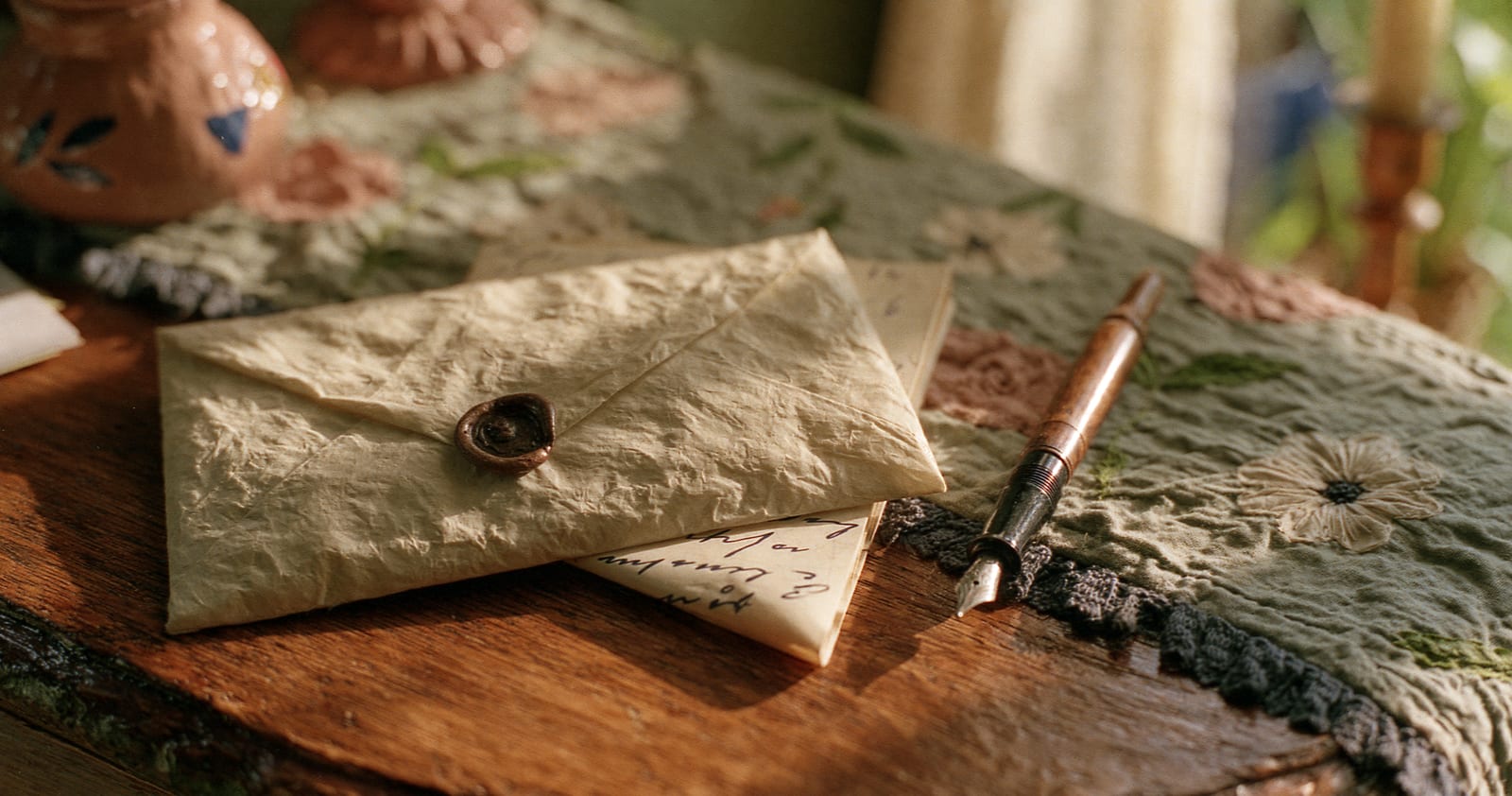
A letter does the work a scanner and a VR headset were reaching for, with paper and ten minutes. You address the future version of you by name, on a date, and the writing drags them out of the fog and into a chair across the table.
Everything above points the same way. The problem is distance: your brain can’t feel the person who’ll inherit your choices. The fix is closeness: make that person real enough to owe something to. A brain scan proves the gap. An age-progressed face narrows it. A handwritten letter, sealed and dated and mailed back to you when you’ve half forgotten writing it, is the version you can actually keep doing.
When you write “Dear future me,” you are not journaling. You’re introducing yourself to a stranger you’ve been dodging, and putting their name on the envelope so they get harder to forward things to. The bill still comes. But now a real person opens it, someone you took a few minutes to know.
That is the whole trick behind the science of writing to your future self: it turns a stranger into someone you’d hate to let down.
If you’d like the practice to hold its own rhythm, the Kind Edition is the slow-mail shape of it. You write once a week, and we mail your own words back to you each month, so the stranger becomes a regular correspondent instead of a name on a note you keep meaning to answer. And if you’d rather begin free, Your Wisest Friend, our free newsletter named for the idea that the wisest friend you have is your future self, sends quiet prompts and good reading, no rush and no spam.
FAQ
Q: Why does my brain treat my future self like a stranger?
A: In brain-scan studies, the region that flags a thought as being about you goes quieter when you picture your future self, drifting toward the pattern it shows for another person. Researchers call your felt closeness to later-you future self-continuity. The thinner that closeness, the more you tend to neglect the person on the other end.
Q: What does “your future self is a stranger” actually mean?
A: It’s a research finding, not a figure of speech. When people imagine themselves years ahead, the brain responds much as it does to a stranger. In those studies, the people whose brains treated future-them most like a stranger tended to save less and grab the smaller reward now, per Ersner-Hershfield, Wimmer, and Knutson.
Q: How can I feel closer to my future self?
A: Make that person specific. In studies, meeting an age-progressed image of your older face nudged people to set aside more for retirement, and writing a dated letter to your future self does similar work with paper. Give the stranger a face, a name, and a stake, and the distance starts to close.
Q: Does writing to your future self really change how you behave?
A: In small, researched ways, yes. Feeling closer to your future self is linked to better saving and steadier follow-through on goals. A letter won’t transform your life overnight, but it makes the person who inherits your choices real enough to protect. Think gentle nudges, backed by studies, not miracles you can order by mail.
One Last Thing
I logged in to that retirement account eventually. What moved me wasn’t a spreadsheet. It was writing to the woman who would be living off it, and finally admitting I’d been treating her like someone I’d never have to meet. She isn’t a stranger now. She’s just me, a little further on, and she opens everything I send.
Write to her this week. She’s closer than your brain is telling you.
Your friend and fellow letter lover, K. Larkin 💌
Before Dear Future Self, K. Larkin trained to carry the mail and fell in love with real letters and how they made people smile. She founded the club after she began writing to a future self she’d long treated like a stranger, and now folds and mails every letter by hand.