· K. Larkin · Future-Self Writing · 9 min read
Does Writing About Your Feelings Help?
Does writing about your feelings help? The research says yes, in small, reliable ways, and most for the heaviest things. An honest and gentle look at it.

Does Writing About Your Feelings Actually Help?
The autumn my friend was in the hospital, I did my crying in a parking garage.
Level three, the same concrete pillar every evening, engine off, a spiral notebook braced on the steering wheel. I couldn’t come apart upstairs where she could see me, and I couldn’t hold it either, so it went onto the page. I wrote to a version of me a year out, and told her how frightened I was.
I’ve wondered since whether that notebook did anything, or only gave my hands something to do. Does writing about your feelings help, or does it just feel like it should?
The honest answer comes with a name attached and forty years of studies behind it. Yes, with an asterisk. The asterisk is the tender part, and it’s the whole reason I’m writing this one gently.
This is one of six benefits we pull apart in the science of writing to your future self.
Does Writing About Your Feelings Help? What the Research Says
Answer first: yes, in small and reliable ways, and most of all for people carrying something heavy. That’s the short version, worth saying plainly before anyone oversells it to you.
Writing about what hurts tends to leave you a little steadier. It doesn’t fix the thing; it steadies the person carrying it. The effect is modest, and it holds up across a lot of studies, which is a rarer thing in this field than you’d hope.
Let me walk you through where that finding comes from, because the story of it is oddly comforting on its own.
The Psychologist Who Timed It
The whole field starts with one stubborn experiment. In 1986, a psychologist named James Pennebaker asked a group of students to write about the hardest thing that had ever happened to them, fifteen minutes a day, four days running. Another group wrote about nothing much: their shoes, the room, plans for the weekend.
Then he waited and counted. In the months that followed, the students who had written about the painful thing visited the campus health center less often than the ones who’d written about their shoes (Pennebaker & Beall, 1986).
One four-day exercise. A measurable difference in how often their bodies sent them to a doctor, months later.
That result was strange enough to set off hundreds more studies. Researchers have since had people write about grief, divorce, job loss, diagnosis, the whole catalog of heavy human events, and measured what changed.
Small, but Real, and Steady
When you pool all that research, the effect is small: real, but small. In 2006, a researcher named Joshua Frattaroli gathered the whole body of expressive-writing studies into a single analysis and ran the numbers (Frattaroli, 2006).
What he found: writing about your feelings produces a modest but dependable improvement in how people feel and function. A lean in the right direction, showing up again and again across studies that had no reason to agree.
I want to be careful here, because this is exactly the place where wellness writing tends to lie to you. The effect is not dramatic. Anyone promising that writing will dissolve your grief or heal an illness is selling something, and it isn’t the truth.
Small and reliable is still worth having. Most things that actually help are small.
Who It Helps the Most
The benefit isn’t spread evenly: it’s largest for the people carrying the heaviest things. That’s the part of the research I find most moving, and the most important to say out loud.
Across the studies, expressive writing did the most for people working through trauma, grief, and serious illness: the ones whose hard thing had nowhere else to go. For someone having a fine week, writing about feelings does a little. For someone in the parking garage, it does more.
This is the opposite of how most self-improvement works. Usually the tools flatter the already-fine and fail the struggling. This one leans toward whoever is hurting most.
A Witness, Not a Cure
Writing doesn’t hand you a solution. It hands you a witness. Understanding that is the difference between the practice helping and the practice disappointing you.
When you put a feeling into words, you take it out of the swirl in your chest and set it on a page where you can look at it. The thing doesn’t leave. But it stops being weather and starts being an object, something with edges, something you can turn over. Naming it loosens its grip by a degree or two.
Sometimes a degree or two is the whole gift.
That’s the honest shape of what the research found. Not that writing heals the wound, but that it gives the feeling a room to be in, and keeps you a little less alone in there while the thing does what it was going to do anyway.
Why a Sealed Letter Is the Gentlest Way to Do It
A letter to your future self takes that plain finding and adds the one thing a journal can’t: a reader. You aren’t writing into a void. You’re writing to a specific person on a specific date, and that person is you, on the far side of this.
Think about who future-you actually is. They’re the one who already knows how it turns out. They’ve read the last page. Whatever you’re frightened of tonight, they survived it, or they’re surviving it, and they’re exactly the person you’d want holding the hard thing with you.
That’s why the parking-garage notebook helped more than plain journaling ever did for me. I wasn’t only venting into paper. I was handing the fear to someone kind, someone I trusted to still be standing when she read it.
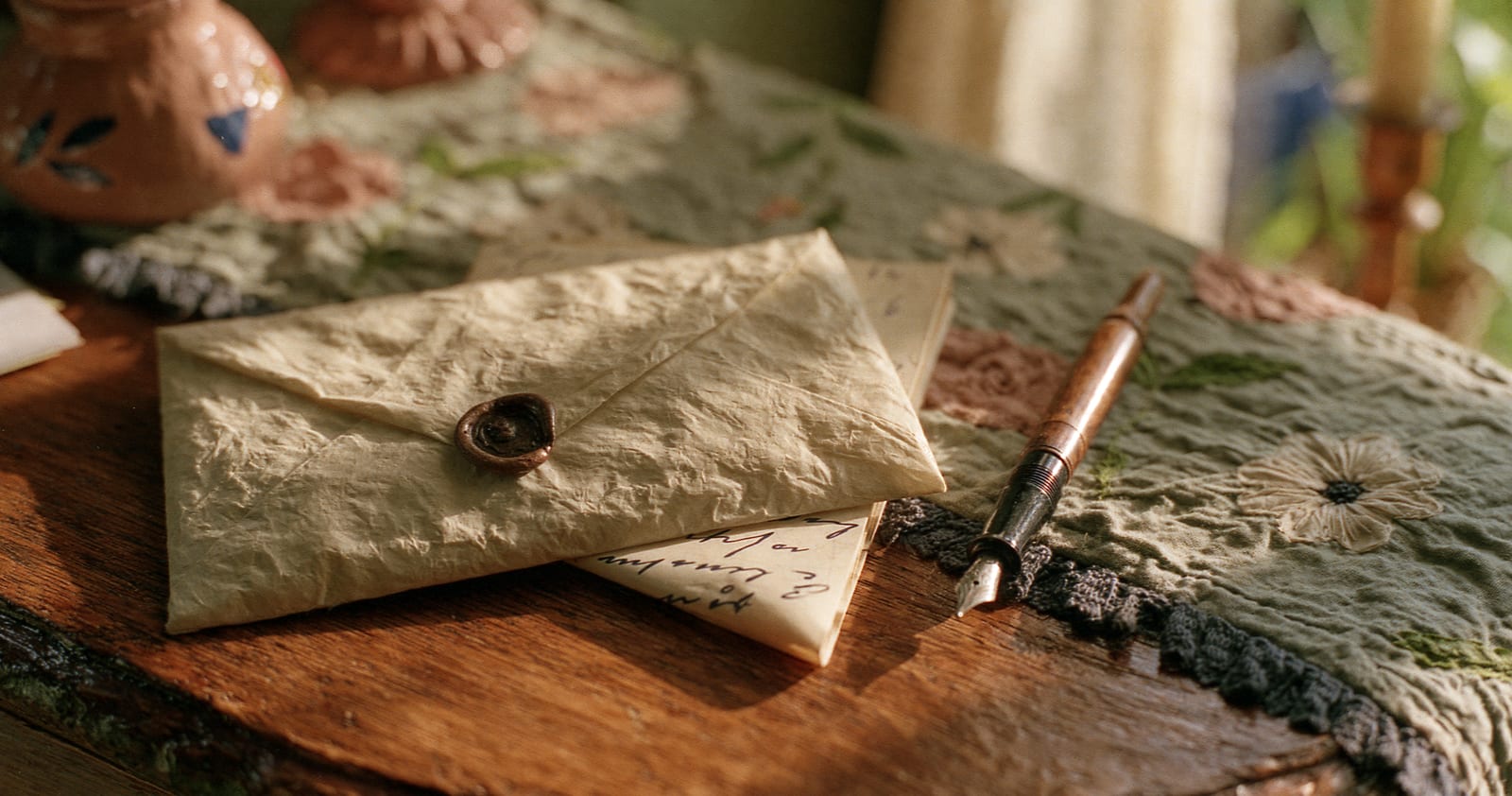
You write the worst of it down. You address it to the one person guaranteed to understand. Then you seal it, which is its own small mercy: the hard thing is said, and set down, and no longer only in your body.
How to Put the Hard Thing on Paper
You don’t need the right words or the right notebook. You need ten minutes and permission to be honest with one person: the you who will read this later.
Address it to yourself, a season or a year out. Then write what’s actually true right now, without arranging it to sound better:
- The hard thing itself, named plainly. The real one, not the version you’d tidy up for a friend.
- What it’s costing you. What you’re afraid of, what you can’t say out loud yet.
- One thing you’re holding onto, however small. A person, a hope, a next morning.
Then tell future-you that you’re trusting them to read this and remember how it felt. Seal it. Put a date on the outside. Set it somewhere you’ll find it when the season has turned.
That’s all it is. Ten quiet minutes and the nerve to be honest on paper.
FAQ
Q: Does writing about your feelings actually help?
A: Yes, in small and reliable ways. Pooled research shows expressive writing gives a modest but dependable lift in how people feel and function, and it helps most for those processing grief, trauma, or illness. It won’t cure anything. What it does is give the hard feeling a place to go.
Q: How does expressive writing work?
A: Putting a feeling into words moves it from a swirl in your body onto a page where it has edges. You can look at it, turn it over, and see it more plainly. Researchers think this naming and ordering is part of why writing about hard things quietly steadies people over the weeks that follow.
Q: Is expressive writing the same as journaling?
A: They overlap, but a letter to your future self points somewhere. A journal talks to the present and stays in the drawer. A letter is addressed to a specific person on a specific date, which gives the writing a direction and a reader: future-you, who already knows how much of this you survived.
Q: Can writing about your feelings make things worse?
A: You might feel briefly lower right after, the way a good cry leaves you tender. In studies that dip passes, and people tend to come out steadier. If a memory feels genuinely unsafe to write about, that’s a sign to reach for a therapist, not a notebook. Gentle and honest beats forced.
Q: How long should I write for?
A: Less than you’d think. The original studies used fifteen minutes a day for four days and found effects from that alone. Ten honest minutes beats an hour of circling. Write until you’ve said the true thing, then stop. You can always come back to it another day.
A Last Word
The notebook from that autumn is in a box in my closet. My mother came home. I don’t reread those pages often, but I know they’re there, and knowing they’re there still steadies me: proof that the frightened version of me had somewhere to put it all, and someone to hand it to.
That someone was just me, later. It usually is.
If you’d like to make this a gentle habit instead of a thing you reach for only in the parking garage, the Kind Edition is the slow-mail version: you write to yourself once a week, and we mail your own words back to you each month.
And if you’d rather start free and unhurried, Your Wisest Friend, our free newsletter named for the idea that the wisest friend you have is your future self, sends quiet prompts and good reading, no rush and no spam.
Write the hard one first. Future-you is the safest person you’ll ever hand it to.
Your friend and fellow letter lover, K. Larkin 💌
Before Dear Future Self, K. Larkin trained to carry the mail and fell in love with real letters and how they made people smile. She founded the club after she began writing to a future self she’d long treated like a stranger, and now folds and mails every letter by hand.